Signal Flip Watch: What Utilities Are Telling Us About Risk
I've found that the market rarely warns you in the language you're expecting. Right now the headlines say inflation is moderating and growth is fine --- and yet core CPI ticked higher to 2.90%, energy inflation accelerated to 23.50%, and utilities, the most rate-sensitive and defensive sector in...

KEY HIGHLIGHTS
- Core Consumer Price Index (Core CPI) is running at 2.90% year-over-year (as of 2026-05-31), with the Cleveland Fed trimmed-mean read at 2.90% --- both ticked higher from the prior print, keeping inflation volatility squarely in the policy debate.[1][2]
- Energy inflation has accelerated to 23.50% year-over-year, and rent inflation to 3.40%, two of the stickiest components.[3]
- The 10-year Treasury yield sits at 4.37% (as of 2026-06-26), with the 10Y-3M curve at 0.71 pp (percentage points) --- a meaningfully different posture from the deep inversion that anchored prior-cycle thinking.[4][5]
- The CBOE Volatility Index (VIX) at 18.53 and the iShares iBoxx $ High Yield Corporate Bond ETF (HYG) at $79.85 (range change -0.27% over the window) describe a market still pricing very little tail risk.[6][7]
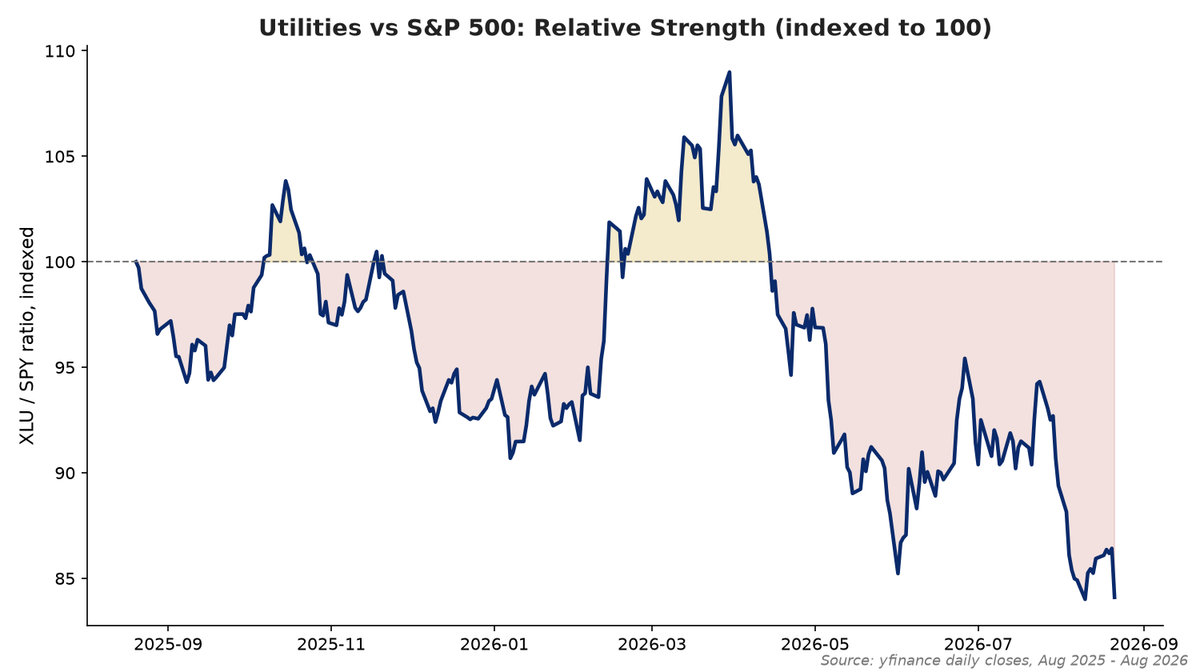
- The XLU/SPY ratio --- a relative-strength ratio dividing the price of the Utilities Select Sector SPDR Fund (XLU) by the price of the SPDR S&P 500 ETF Trust (SPY), used as an intermarket indicator of whether defense or offense is being priced by the market --- sits at 0.0632 (-2.09% over the window, with XLU at $46.23 and SPY at $731.23). The posture this week is offensive --- SPY has been leading utilities.[8]
I've found that the market rarely warns you in the language you're expecting. Right now the headlines say inflation is moderating and growth is fine --- and yet core CPI ticked higher to 2.90%, energy inflation accelerated to 23.50%, and utilities, the most rate-sensitive and defensive sector in the index, keep flashing signals that deserve attention. In my view, the most important question isn't whether the next macro print is "hot" or "cool." It's whether the intermarket message has already changed beneath the surface.
THE MACRO BACKDROP: A QUIETER TAPE THAN THE DATA WARRANTS
Inflation has not gone away. Core CPI is running near 2.90% year-over-year and the Cleveland Fed trimmed-mean read sits at 2.90% --- both higher than the prior print, not lower.[1][2] Energy at 23.50% year-over-year is the clearest example: that is not the print of a disinflation that is finished.[3] A 10-year Treasury yield at 4.37% and a 10Y-3M curve at 0.71 pp together describe a market that has decided the worst is behind it.[4][5]
That decision may be right. It also may be premature.
THE UTILITIES MESSAGE: A BOND-PROXY SECTOR LEADING IS NOT NORMAL IN A "RISK-ON" REGIME
Utilities (XLU) are the textbook bond-proxy sector --- high dividend yield, rate-sensitive, defensive by construction. When XLU begins to outperform SPY on a relative-strength basis, it is rarely a bullish signal for broad equities. It is a signal that capital is quietly rotating toward defense.
The XLU/SPY ratio currently reads 0.0632, with XLU at $46.23 and SPY at $731.23. Over the window I'm watching, the ratio has moved -2.09% --- offensive --- SPY has been leading utilities.[8] That is exactly the kind of relative-strength data the ATACX process is built to act on.
This is the core mechanism behind ATACX. The fund uses a weekly utilities-versus-SPY ratio to decide whether to be offensive (broad equity exposure via SPY) or defensive (Treasuries, cash equivalents). The rule is unambiguous: when XLU is leading SPY, the signal is risk-off; when SPY is leading XLU, the signal is risk-on.
It is not a forecast. It is a response framework.
WHY THIS MATTERS NOW
With VIX at 18.53 and HYG at $79.85, the price of being wrong on direction has rarely been higher.[6][7] When everyone is positioned the same way, the cost of an unexpected regime shift is paid disproportionately by those without a process to respond.
ATACX is built for exactly that kind of asymmetry. The fund's holdings rotate weekly based on the signal --- not on a story, not on a thesis, not on a guess about the next Fed move.
THE BOTTOM LINE
The market is telling you it is calm. Utilities are telling you to pay attention. In my experience, when those two signals disagree, the disagreement itself is the information.
ATACX exists to act on that disagreement on a rules-based weekly cadence, not to debate which signal is "right." That is the whole point of process-driven rotation: you don't have to know what happens next. You only have to know what to do when the signal changes.
ENDNOTES
[1] U.S. Bureau of Labor Statistics, Core CPI year-over-year (Trading Economics: USACORECPIRATE) --- https://tradingeconomics.com/united-states/core-inflation-rate
[2] Federal Reserve Bank of Cleveland, Trimmed-Mean CPI (Trading Economics: UNITEDSTACPITRI) --- https://tradingeconomics.com/united-states/core-consumer-prices
[3] U.S. Bureau of Labor Statistics, Energy CPI year-over-year --- https://tradingeconomics.com/united-states/energy-inflation
[4] U.S. 10-Year Treasury yield (\^TNX) daily close via Yahoo Finance --- https://finance.yahoo.com/quote/%5ETNX
[5] 10-Year minus 3-Month Treasury spread, computed from \^TNX and \^IRX daily closes --- https://finance.yahoo.com/quote/%5ETNX
[6] CBOE Volatility Index (\^VIX) daily close via Yahoo Finance --- https://finance.yahoo.com/quote/%5EVIX
[7] iShares iBoxx US High Yield Corporate Bond ETF (HYG) daily close --- credit-stress proxy --- https://finance.yahoo.com/quote/HYG
[8] XLU/SPY relative-strength ratio, daily closes via Yahoo Finance --- ATACX intermarket signal --- https://finance.yahoo.com/quote/XLU
DISCLOSURES (ATACX)
Investors should carefully consider the investment objectives, risks, charges and expenses of the ATAC Rotation Fund (ATACX) before investing. This and other information can be found in the Fund's prospectus and summary prospectus, which may be obtained by visiting atacfunds.com. Read the prospectus carefully before investing.
Mutual fund investing involves risk, including possible loss of principal. There is no guarantee that the Fund will achieve its investment objective. The ATAC Rotation Fund is distributed by Foreside Fund Services, LLC